Email: info@oudreywatertank.com
Whatsup: +86159 1014 5521
Learn fire water tank connection sizes, inlet, outlet, overflow pipe requirements, and Chinese vs international fire piping standards.
With the rapid urbanization process in developing countries and the increasing renovation demand for aging buildings and infrastructure in developed countries, the requirements for building fire safety and infrastructure upgrades continue to grow. A reliable and stable fire water storage system has become an essential component of modern building fire protection systems.
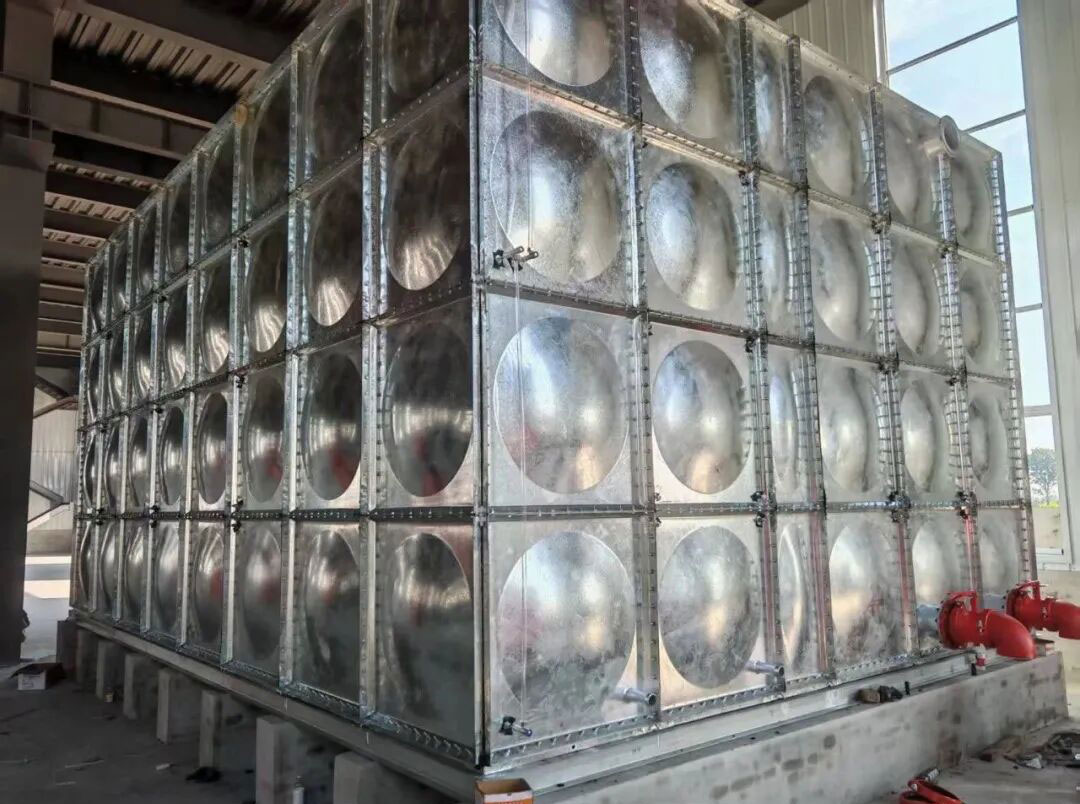
As a key water storage facility in fire protection systems, fire water tanks must not only meet capacity and safety requirements but also provide excellent corrosion resistance, easy installation, and long-term operational stability. Among various types of fire water tanks, hot-dip galvanized fire water tanks have become a widely adopted solution for global building fire protection, pump and valve systems, and engineering projects due to their excellent corrosion resistance, long service life, modular installation advantages, and cost-effectiveness.
In addition to the tank material itself, the compatibility of connection sizes and piping standards is also a common concern during the procurement and installation of fire water tanks. Different countries and regions adopt different fire protection codes, piping standards, and flange specifications. Correct selection of inlet, outlet, overflow, and other connection sizes is essential to ensure the safe and reliable operation of the fire protection system.
The following section introduces common fire water tank connections and related standard requirements.
| Item | Chinese Standard Requirements | Common International Practice |
|---|---|---|
| Minimum Diameter | ≥ DN32 | Usually determined according to make-up water flow requirements |
| Design Requirement | The pipe size should ensure that the fire water tank can be fully refilled within the specified time (such as 8 hours) | Determined based on the water supply capacity of the fire protection system |
| Control Method | Float valve or level control valve is recommended | Float valves and automatic level control valves are commonly used |
The inlet pipe is generally not the key pipe affecting fire water supply capacity, and its diameter is usually smaller than the outlet pipe.
Common configurations:
| Item | Chinese Standard Requirements | Common International Practice |
|---|---|---|
| Minimum Diameter | ≥ DN100 | Usually DN100–DN200 |
| Function | Connects to the fire piping network to provide emergency water supply | Connects to fire pumps, fire risers, or fire loops |
| Anti-vortex Requirement | Sufficient submergence depth is required | NFPA 22 also requires measures to prevent air entrainment |
| Building Type | Common Outlet Size |
|---|---|
| Small Buildings | DN100 |
| Commercial Buildings | DN100–DN150 |
| Factories and Warehouses | DN150 |
| Large Fire Protection Systems | DN200 or larger |
Outlet size: DN100 / DN150
Among them, DN150 is commonly used for large-scale international fire protection projects.
| Item | Requirement |
|---|---|
| Minimum Diameter | ≥ DN100 |
| Diameter Relationship | Not less than twice the diameter of the inlet pipe |
| Function | Prevents water overflow when the tank is full |
Common international practice:
| Item | Chinese Standard | Common International Standard |
|---|---|---|
| Minimum Diameter | DN100 | DN100 (4 inch) |
| Recommended Size | DN150 | DN150 (6 inch) commonly used |
| Pipeline Layout | Ring network preferred | NFPA recommends looped systems for higher reliability |
Common international fire main sizes:
Large industrial projects such as factories, warehouses, and airports may use:
Chinese requirements:
International standards such as:
also emphasize:
| Item | Chinese Requirement | International Practice |
|---|---|---|
| Recommended Velocity | ≤ 2.5 m/s | Usually around 2–5 m/s |
| Maximum Velocity | ≤ 7 m/s | Limited according to system pressure and design requirements |
International fire protection projects mainly use the following connection methods:
Applications:
Advantages:
Commonly used for:
Suitable for:
| Connection | Recommended Size |
|---|---|
| Inlet | DN50–DN100 |
| Fire Water Outlet | DN100–DN150 |
| Overflow | DN100–DN150 |
| Drain | DN50–DN100 |
| Vent | DN50–DN100 |
| Manhole | DN600 |
| Item | Chinese GB Standards | International NFPA / EN Standards |
|---|---|---|
| Fire Water Tank Outlet | ≥ DN100 | Usually DN100–DN200 |
| Outdoor Fire Main | ≥ DN100, DN150 recommended | 4″–6″ commonly used |
| Indoor Fire Piping | Ring system preferred | Ring system preferred |
| Pipe Connection | Flange, grooved, flexible coupling | Grooved and flange connections widely used |
| Anti-vortex Requirement | Clearly specified | Also emphasized in NFPA 22 |
| Connection Size System | DN system | DN / NPS inch system |
As one of China’s leading modular water tank manufacturers, we have extensive project experience and provide one-stop fire water tank solutions, including system design, customized structure, connection configuration, manufacturing, and installation guidance.
The outlet pipe should generally be DN100 or larger.
Common inlet sizes are DN50–DN100, depending on tank capacity.
The overflow pipe is usually DN100 or larger.
Common fire mains are DN100, DN150, and DN200.
Yes, inlet, outlet, and flange standards can be customized based on project requirements.