Email: info@oudreywatertank.com
Whatsup: +86159 1014 5521
Compare square modular and corrugated round water tanks by structure, cost, space, applications, and project needs.
If you have paid attention to water tank projects in Africa, Australia, and other overseas markets, or if you are engaged in related industries, you may find a very interesting phenomenon:
That is, why are large corrugated round water tanks mostly used in farms, ranches, and rainwater harvesting projects, while square modular water tanks are mostly used in factories, hotels, hospitals, fire protection, and commercial building projects?
They are both large water tanks. Why are there two completely different choices?
In fact, there is no simple statement that says “which one is better” between corrugated round water tanks and square modular water tanks. Both are mature and market-verified water storage solutions. The biggest differences between them are: different project requirements, different usage environments, different space conditions, and different cost requirements.
Simply put:
Corrugated round water tanks are more suitable for large-capacity water storage projects with open sites and low land costs; square modular water tanks are more suitable for building spaces and engineering projects with high requirements for space utilization.
Below, let us compare the differences between square modular water tanks and corrugated round water tanks and give you the answer directly.
| Project | Square Modular Water Tank | Corrugated Round Water Tank |
|---|---|---|
| Main Advantages | Flexible capacity customization and high space utilization | Large capacity, structural advantages of the circular shape, and low cost |
| Typical Applications | Buildings, fire protection, industrial, commercial, and other indoor and outdoor applications | Farms, ranches, rainwater harvesting, and other outdoor applications |
| Land / Space Requirements | Suitable for various space-constrained or land-cost-intensive scenarios | Suitable for open sites, low land costs, and scenarios with low requirements for overall space utilization |
| Structure and Accessories | Water tank panels, horizontal tie rods, vertical support rods, diagonal braces, foundation channel steel, rubber sealing strips, leak-stopping plugs, internal and external ladders, flanges, bolts and nuts, water level gauge, inspection opening, etc. | Galvanized steel corrugated panels, roof support columns (optional), roof panel support square tubes (optional), color steel roof panels (optional), steel wire, anti-scratch inner liner, food-grade waterproof fabric/PVC waterproof fabric, U-shaped rubber strip fixing, internal and external ladders, flanges, bolts and nuts, water level gauge, inspection opening, etc. |
| Structural Cost | Complex structure, requiring a large number of tie rods and support rods, resulting in higher costs | Simple internal structure, with fewer tie rods and support structures, resulting in lower costs |
| Export Transportation Cost | Similar transportation costs. Square panels are regular and have high space utilization, but there are more accessories | Similar transportation costs. Corrugated round panels occupy slightly more space, but there are fewer accessories |
| On-Site Assembly Period | Similar for small projects; the period for large projects is slightly longer, and the installation speed is slightly faster | Similar for small projects; the period for large projects is slightly shorter, and the installation speed is slightly slower |
| On-Site Adjustment Flexibility | The curvature of the water tank panels is calculated according to the diameter. On-site adjustment can only be made to the height, and the diameter cannot be adjusted | Modular assembly, with length, width, and height adjustable according to requirements |
| Construction Foundation Conditions | Round or square hardened concrete ground | Concrete strip foundations or channel steel |
| Leak Prevention | Relies on the water tank body and rubber strips, with the water directly contacting the water tank | Relies on the waterproof fabric; the water tank body does not directly contact the water and does not have its own leak-proof capability |
| Water Tank Panel Materials | Common stainless steel, hot-dip galvanized steel, and fiberglass materials, with high corrosion-resistance requirements | Common galvanized steel panels, with corrosion resistance lower than that required for square modular water tanks |
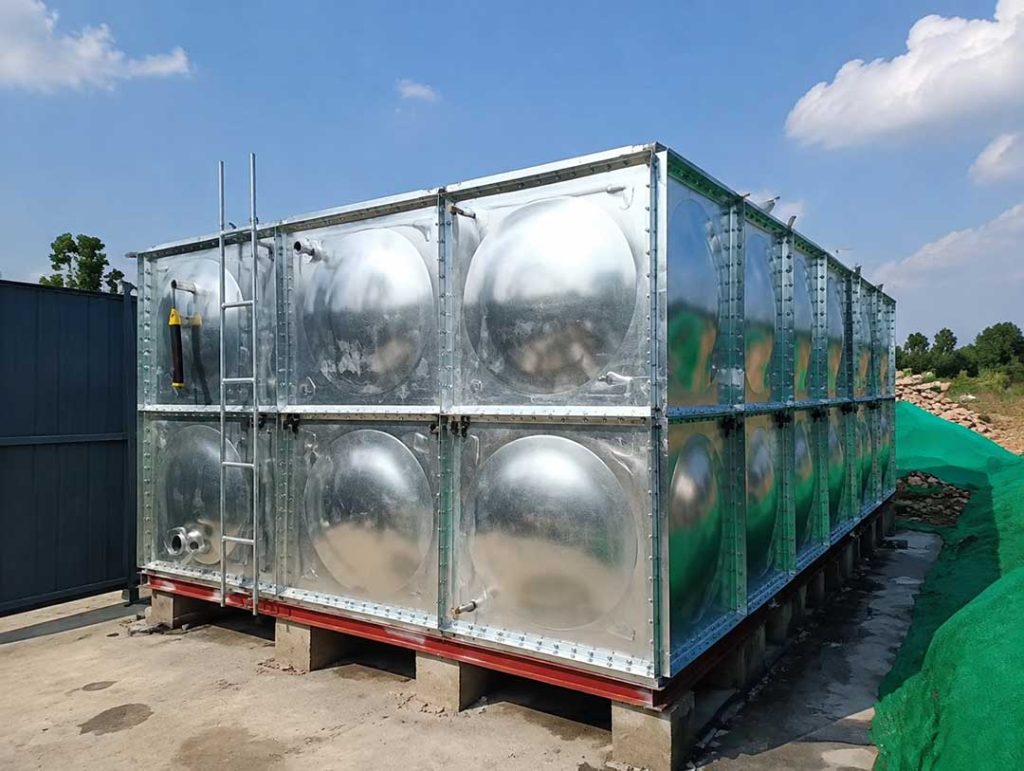
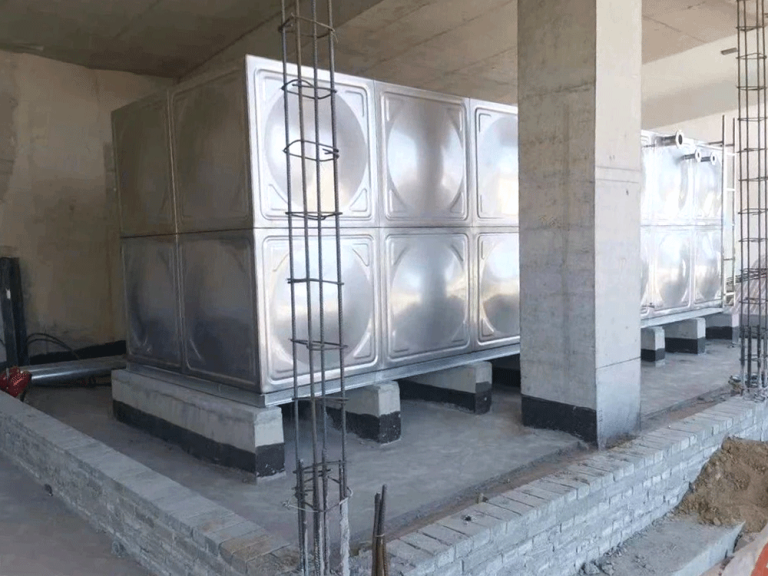
For most people, it is rare to see square modular water tanks directly in daily life. This is because in hotels, hospitals, factories, schools, residential buildings, data centers, shopping malls, and other buildings, water tanks are often installed in relatively hidden locations such as equipment rooms, basements, building platforms, or rooftop spaces.
In actual projects, water storage equipment is often used as supporting equipment for buildings. Its capacity and dimensions have already been limited by the building space. The water tank needs to adapt to the available building space and maximize the utilization of the known space.
In the same space, compared with round water tanks, square water tanks have a larger capacity. Moreover, the modular design of square water tanks is not only suitable for relatively regular cubic spaces, but can also be assembled like “Tetris” into irregular structures, making it more adaptable to environmental spaces.
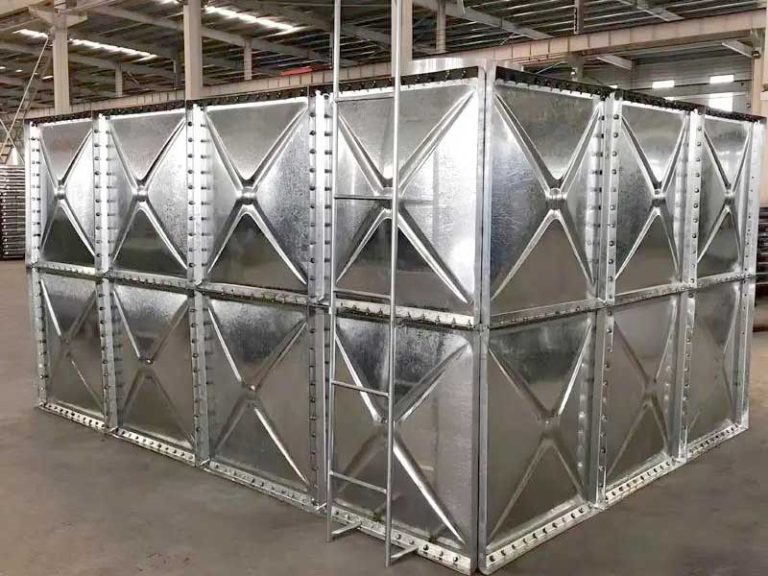
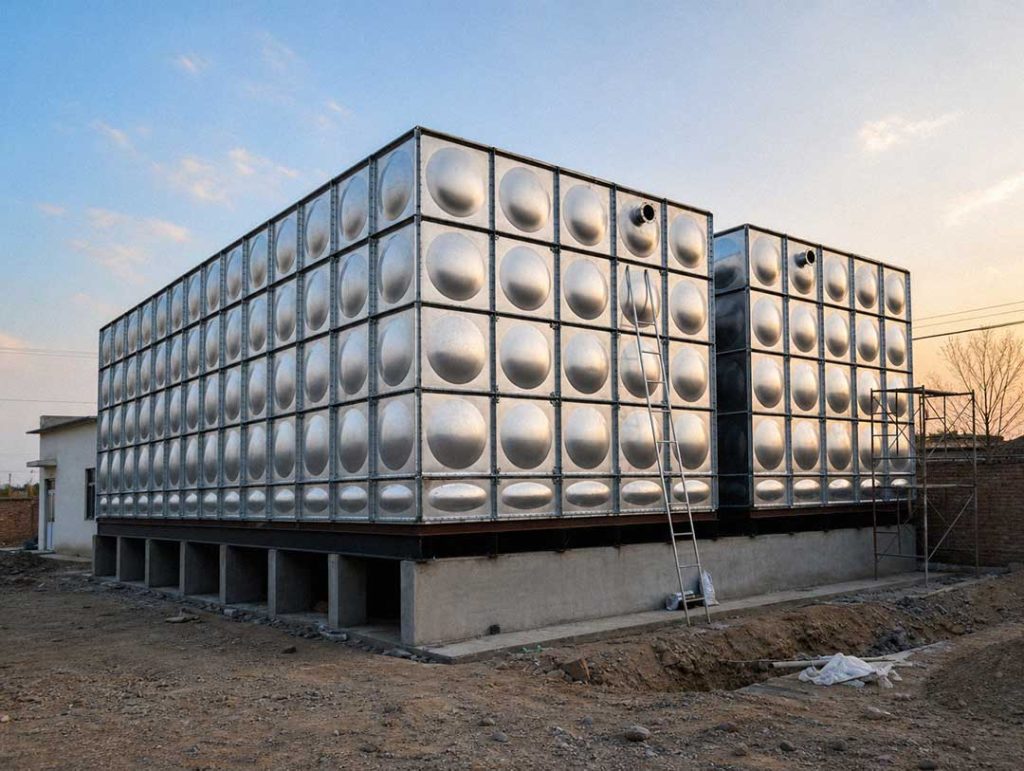
The common materials of square modular water tanks are stainless steel, hot-dip galvanized steel, and fiberglass. They are usually assembled from standardized panels. Standard specifications include 1.22 × 1.22 m, 1 × 1 m, 1 × 0.5 m, and 0.5 × 0.5 m.
By increasing or reducing the number of panels, water tanks with different lengths, widths, and heights can be formed. For example: 50 m³, 100 m³, 200 m³, 500 m³, and even larger capacities.
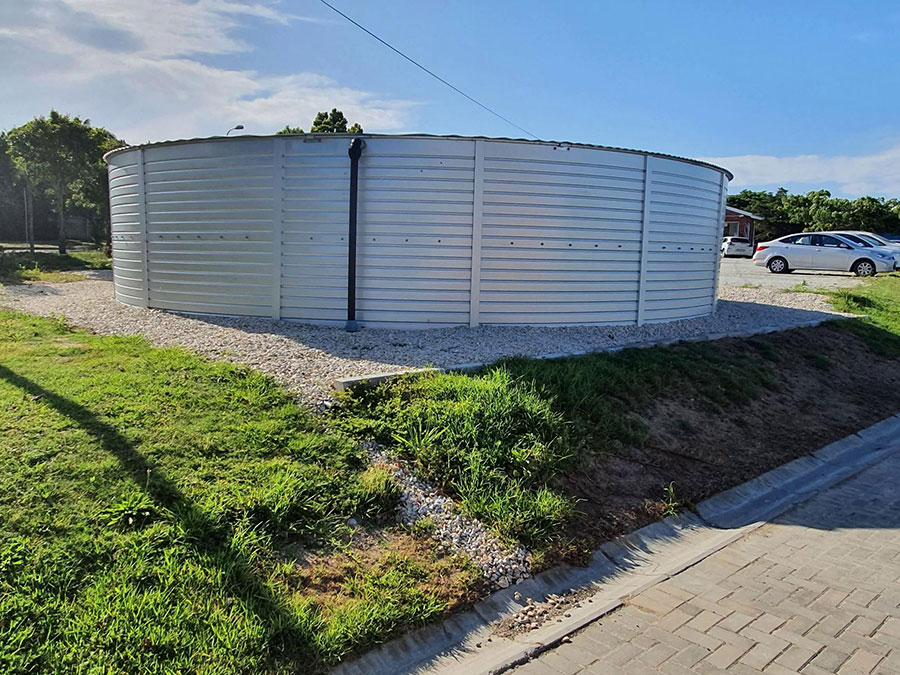
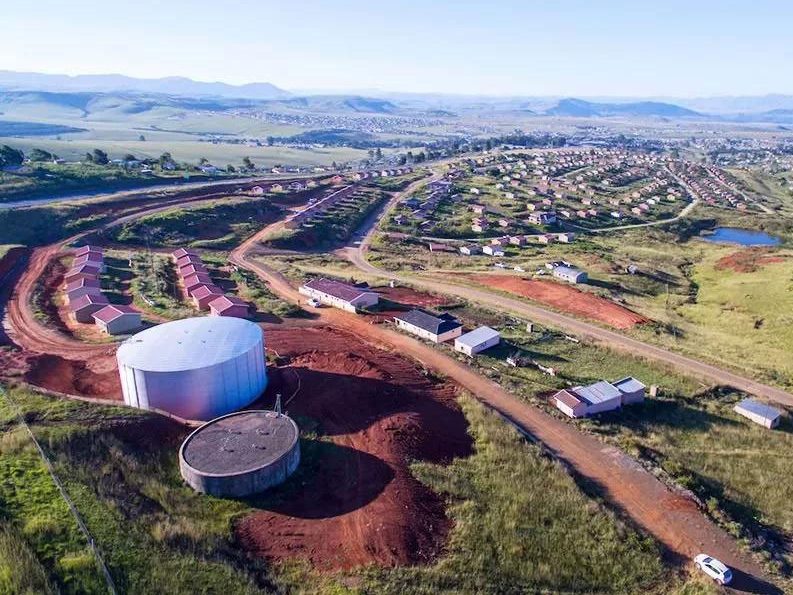
In markets such as Africa and Australia, corrugated steel round water tanks are a very common type of water storage facility. Especially in agricultural irrigation, livestock farming, rural water supply, and rainwater harvesting projects, you can often see large round water tanks.
These projects usually have several common characteristics: sufficient land, large water storage capacity, relatively open installation environments, and low-cost requirements, while the requirements for space utilization are not as high as those of building projects.
The circular structure naturally has the advantages of uniform force distribution and structural stability. The internal pressure of the water tank can be evenly converted into hoop stress, allowing the load to be continuously distributed along the entire circumference. At the same time, the corrugated structure increases the stiffness of the flat steel panels, so it does not need to use a large number of internal tie rods like square modular water tanks to resist water pressure, which greatly reduces the construction cost of the water tank. Therefore, corrugated round steel water tanks are very suitable for large outdoor water storage projects in regions such as Africa and Australia.
For example, a farm needs to store 100 m³, 200 m³, or even more agricultural water. For this type of project, the most important question is not: “Space utilization?” but: “Can a large amount of water be stored at a reasonable cost?”
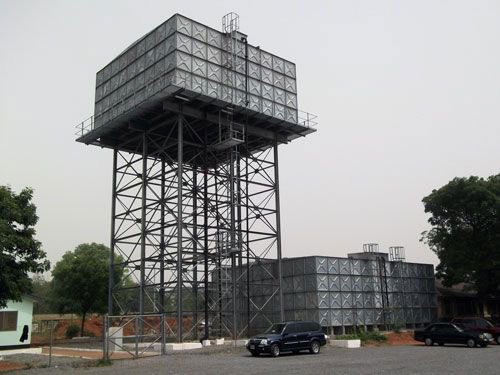
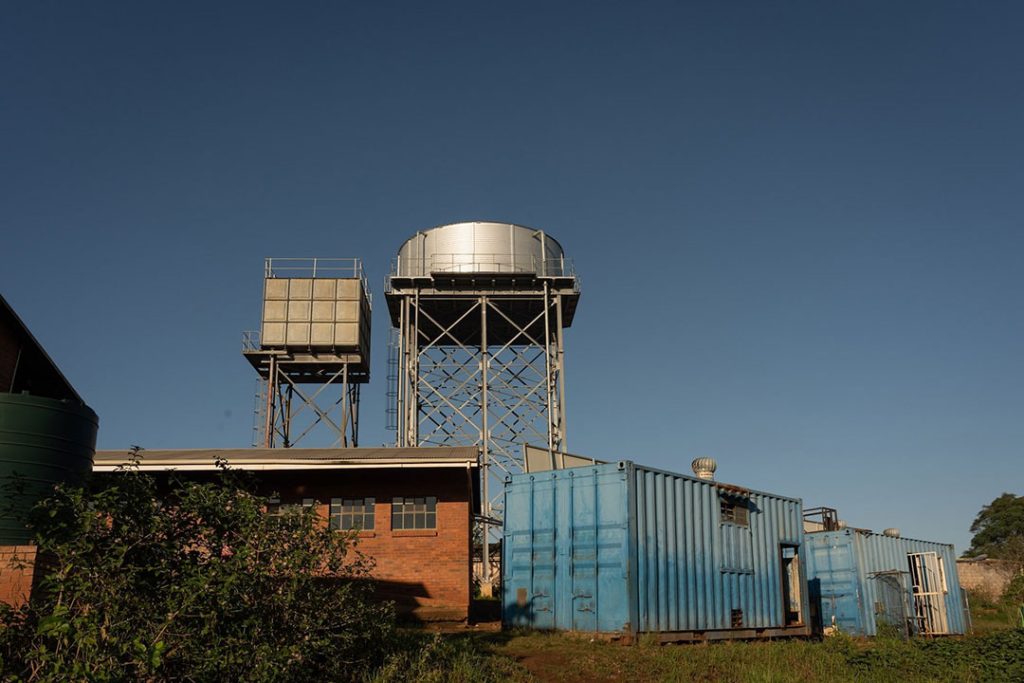
Of course, square modular water tanks + steel towers are also commonly used in Africa. By using the gravity of water, this solution can solve the problem of water supply in some areas where water and power supply are unstable.
You may wonder why not use a corrugated round water tank + steel tower. In fact, this is also a common solution. However, on a limited tower platform, the storage capacity of a square water tank is greater than that of a corrugated round water tank. The core selection factors are still cost and capacity.
If your project is located on a large farm and needs to store a large amount of rainwater, a corrugated round water tank may be a very reasonable choice. Corrugated round water tanks have been market-verified for a long time and have very mature applications in large outdoor water storage fields such as agriculture, ranching, and rainwater harvesting.
If your project is located in:
then a square modular water tank is more worthy of consideration.
No type of water tank is suitable for all projects. There is no absolute “best” water tank, only a solution that is more suitable for the project.
Square water tanks have high space utilization and are suitable for building and engineering projects; corrugated round water tanks have large capacity and low cost, making them more suitable for farms and outdoor water storage.
Square water tanks can be flexibly adjusted in length, width, and height, making them easier to adapt to limited spaces such as basements, equipment rooms, and rooftops.
The circular structure allows internal water pressure to be distributed along the circumference, forming continuous hoop stress and making the overall load distribution more uniform and stable.